The Auction-Lot Audit: Judging Second-Hand Jewellery Tools Before You Buy
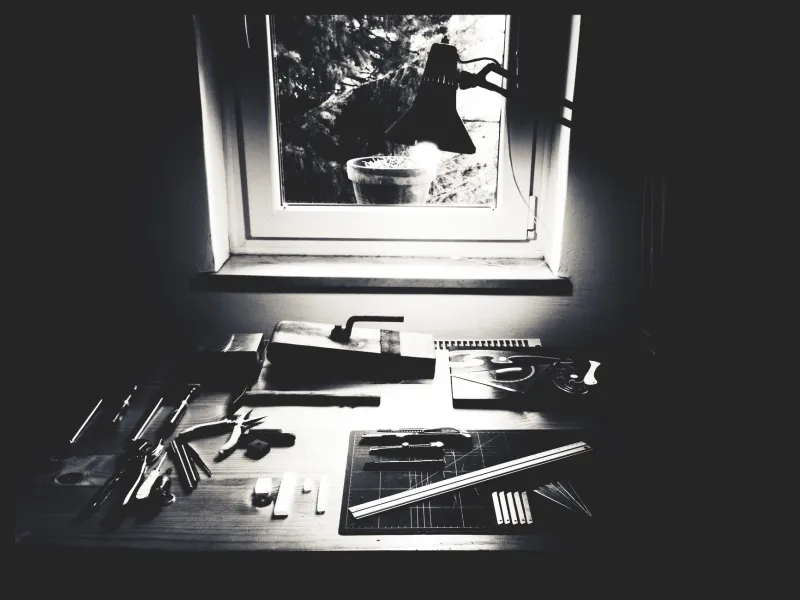
Photo: second hand jewellers tools inspection on workbench, vintage pliers files rolling mill, UK workshop, via promova.com
Second-hand tools are a sensible route into a first bench. A well-made file, a sound pair of pliers or a small rolling mill can outlast several owners, and the UK market — salerooms, tool fairs, online listings and car-boot stalls — is deep enough that most students will meet the question sooner or later. The difficulty is that jewellery tools wear in ways that photographs do not reveal, and some wear is a safety matter rather than a cosmetic one. The disciplined approach is to treat each purchase as an audit: establish the task, test the evidence, price the risk.
Begin with the task, not the lot
A tool is only a bargain if it does the work required of it. Before inspecting a second-hand item, define the operation: cutting sheet, drawing wire, forming curves, rolling stock or holding work at the bench. A heavy engineering file may be excellent value but unsuitable for fine jewellery; a large rolling mill may be sound yet impractical in a small room. At Holt's Academy, students are encouraged to buy for the next twelve months of work rather than for an imagined future workshop. That single constraint removes many tempting but inappropriate lots.
Provenance: the questions that narrow the field
The seller's account of a tool's history is not proof, but it is useful evidence. Ask whether the item came from a trade bench or a hobbyist, what materials it worked and whether it has been stored in a damp workshop or garage. Tools used only on precious metals are generally preferable to those used on base metals, solder and lead, because contamination can transfer to new work. For electrical items, ask about PAT testing and the age of the flex and plug; a failed test is a cost to add to the price.
The channel matters as much as the item. At a UK saleroom, the buyer's premium and VAT can add a substantial percentage, viewing is essential and lots are usually sold as seen. A private online seller may offer no return, while a business seller must describe used goods accurately under consumer law. Ask for receipts or serial numbers where they exist, and be cautious of tools offered without any account of their origin. None of this guarantees quality, but it separates a considered purchase from a speculative one.
The bench-side inspection
Inspection should be systematic and, where possible, conducted in good light with a magnifier and a straightedge. For files, examine the teeth for pinning and polish, check the tang for rust and test the cut on a piece of brass or mild steel; a file that skates is worn, and re-cut files are rarely worth the risk unless their history is known. Pliers and shears deserve close attention at the pivot: open and close them slowly, feel for play, check that the jaws meet evenly and test the cutting edges on copper foil. A sprung or misaligned jaw is a persistent annoyance; a cracked jaw is a hazard.
Hammers, stakes and bench pins should be checked for cracks, mushrooming and loose heads. A light tap with a small hammer can reveal a dull sound that suggests a fissure in cast iron, while a ring test is useful for anvil-like forms. Never accept a hammer with a damaged face or a loose head, and treat welded repairs on struck tools as a reason to walk away. Bench pins should be free of splits and firmly mounted; a soft or split pin will move under the saw and spoil fine work.
Rolling mills require the most patient examination. Turn the rolls by hand and feel for backlash in the gears, binding or uneven resistance. Inspect the roller surfaces for pitting, scoring and hourglass wear, check the frame for cracks near the adjusting screws and confirm that guards and tommy bars are present. Drawplates should be checked for bell-mouthed holes and deep scratches; rotary handpieces for bearing noise and collet wear. In every case, the question is not whether the tool looks old — most good tools do — but whether its wear is uniform, visible and priced in.
Hidden faults and safety
Some defects are not merely inconvenient. Cracked castings, damaged insulation, seized adjusters and unknown torch regulators can turn a cheap lot into a liability. A tool that fails a safety check is not a bargain at any price. Dust and residue from unknown materials also deserve caution, particularly where a tool has been used on lead or unusual alloys. Where electrical equipment is concerned, factor in the cost of testing and, if necessary, rewiring before the item is used at the bench.
The arithmetic of a fair price
Fair pricing starts with the new price from a reputable UK supplier, not with the seller's asking figure. Files and small hand tools depreciate heavily and should be inexpensive unless genuinely unused. Pliers and shears in good order commonly sell for a modest fraction of new, while rolling mills and anvils hold value and may justify a higher price if the condition is sound. Add the buyer's premium, VAT, travel, postage and any repair or testing cost before comparing the total with a new item. As a working rule, if the likely repair exceeds roughly two-fifths of the new price, the purchase is a project rather than a saving.
When the bargain is a repair project
A repair project can be worthwhile for a student who wants to learn, provided parts are available and the fault is understood. It is not worthwhile when the fault is structural: cracked frames, worn gear teeth, seized threads, missing proprietary parts or damaged electrical windings. The same applies to tools that have been heavily modified or re-ground without a clear record. In those cases, the honest description is not 'bargain' but 'donor part'.
A short buyer's checklist
- Confirm the tool suits the work planned for the next year.
- Ask about prior materials, storage conditions and electrical testing.
- Inspect pivots, jaws, faces, rollers and frames in good light.
- Test files on brass; test shears on copper foil.
- Calculate premium, VAT, travel and repair before bidding.
- Walk away from cracks, loose heads, damaged insulation and seized adjusters.
- Prefer tools with a return option or a viewing period.
Second-hand buying rewards patience and a bench eye. The aim is not to acquire the most tools but to acquire sound ones, and to know the difference before the money leaves the account.