Small Room, Real Hazards: Zoning a Home Jewellery Bench in the UK
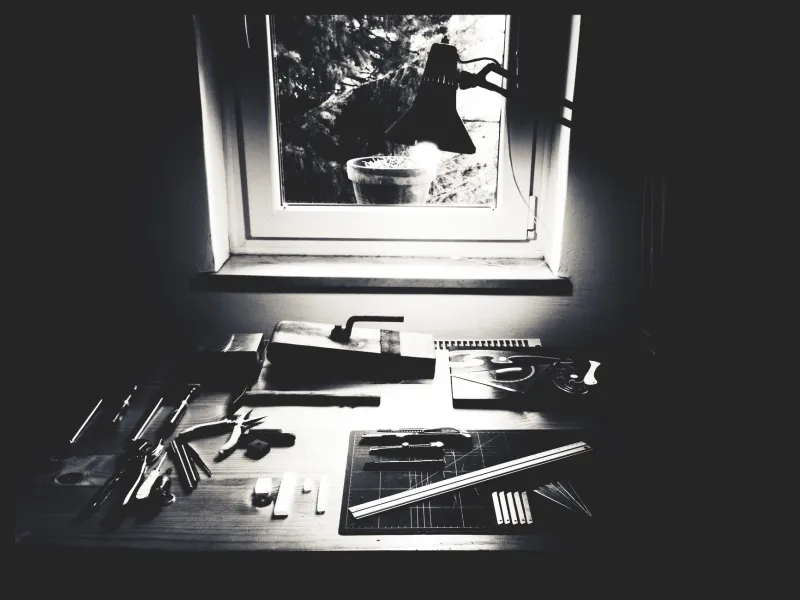
There is a particular kind of photograph that circulates online: a spare-room bench, a wall of pliers, a neat row of files, and no visible means of extraction. It is an attractive image and, for many students, a misleading one. Setting up at home is possible, and often necessary for anyone studying part-time or building a portfolio between short courses. But the order of work matters. The safe home bench begins with limits, not equipment.
Start with the limits, not the catalogue
The first question is not which micromotor to buy but which processes will be permitted in the room. Soldering, enamelling, resin work, acid pickling, polishing with abrasives and hammering all carry different risks, and a small domestic room can support some of them comfortably while making others genuinely unwise.
A workable hierarchy, used by several UK part-time tutors, is to separate clean work from hot and dirty work. Filing, sawing, wire work and cold connections can live almost anywhere with decent light and a surface that can be protected. Soldering, pickling, polishing with compounds and any heated chemical process should be confined to one clearly defined position with extraction and fire precautions, and some should not happen indoors at all.
Ventilation: the non-negotiable
Domestic rooms are not workshops, and the standard advice is blunt: if a process produces fume or fine particulate, it needs to leave the room. Opening a window is a start, not a solution, particularly in a modern flat with restricted openings.
For occasional soft soldering and small silver soldering jobs, a bench-top extraction unit with a flexi-arm and appropriate filter, ducted towards an open window, is the usual compromise. Filters require replacement on schedule; a saturated filter is worse than none, because it gives the appearance of control without the substance. Pickle should be kept in a sealed, labelled container, well away from food, and never heated in an unventilated room. Resin, polymer clay and any dust-producing abrasion work call for wet methods, local extraction or a move outdoors.
It is also worth naming what a home bench cannot do. Spray booths, kilns, large-scale casting and anything involving substantial quantities of solvent belong in a properly equipped workshop, whether that is a college facility, a community studio or a paid bench share.
Fire: small room, real risk
A jeweller's torch in a bedroom is a serious proposition. Soft furnishings, papers and synthetic carpets are all within a metre of most improvised benches, and a small flame in an enclosed space has nowhere to vent.
Minimum precautions are inexpensive and non-negotiable. Solder on a fireproof board or a steel tray, never directly on a wooden surface. Keep a fire blanket and an appropriate extinguisher within reach, and know which extinguisher suits which fire; a water extinguisher is not suitable for electrical equipment. Tie back hair, remove loose sleeves, and clear the bench of paper before lighting up. Never leave a torch running unattended, even for a moment.
Cylinders deserve specific mention. Many UK tenancy agreements and leasehold covenants prohibit the storage of gas cylinders in flats, and it is sensible to check before purchasing a propane or butane set-up. Small water torches and disposable hand torches offer a middle route for light work, subject to the same ventilation and fire discipline.
The paperwork nobody mentions
Two documents govern most home benches, and neither is usually discussed in the studio. The first is the tenancy agreement or lease. Standard assured shorthold tenancies commonly restrict business use, and freeholder covenants in blocks of flats may go further. A student selling occasional work from home is in a different position to one running a small production line, and it is worth asking the question directly rather than assuming.
Before any business use, notify the landlord and check the position in writing. For those with a mortgage, the lender's terms may also be relevant.
The second is insurance. Standard UK home contents policies typically exclude business equipment and any process involving heat, and a claim arising from a workshop fire in a spare bedroom may be declined. Specialist craft or home-business extensions exist and are usually modest in cost compared with the risk. Anyone teaching from home, even informally, should also consider public liability cover.
Storage that closes
In a shared house, storage is a safety measure as much as a tidiness one. A lockable cupboard or a deep drawer that closes fully does several jobs at once: it keeps sharp tools, flux, pickle and small findings away from children, pets and visitors, and it prevents fine metal dust from migrating into living space.
Label everything. Keep pickle in glass or heavy plastic with a sealed lid, never in an unmarked drinks bottle. Store solder, fluxes and chemicals separately from tools. A simple inventory taped inside the cupboard door is useful for housemates and for insurance purposes alike.
Noise and the neighbours below
Hammering travels. In a Victorian terrace the sound goes down and sideways; in a modern flat with timber floors it goes straight through. Practical mitigations include a heavy block of hardwood or a steel bench block set on a rubber mat, hammering restricted to sociable hours, and a word with neighbours before a deadline week rather than after it.
Rotary tools and flex-shaft motors produce a continuous whine that is more irritating than loud. Placing the motor on a foam pad and keeping sessions short reduces complaints considerably.
Zoning a shared room
Where the bench must share space with a dining table or a desk, zoning does the heavy lifting. Choose one end of one surface, mark the boundary, and cover it with a sacrificial mat that can be rolled away. Adopt a closing routine: tools down, sweepings collected, mat shaken out, cupboard shut. Metal filings and swarf have a way of appearing in carpets weeks later.
Keep food and drink entirely outside the zone, and never store tools or chemicals where food is prepared. Light is often overlooked; a daylight lamp plus a small task lamp costs less than a single ruined piece.
A working checklist
Before the first torch is lit at home, a student should be able to answer yes to each of the following. Is extraction in place and the filter in date? Is a fire blanket within reach and an extinguisher of the right type? Has the landlord confirmed the position on business use in writing, and does the contents policy cover the equipment and the processes? Are chemicals sealed, labelled and stored away from food? Is there a closing routine that returns the room to domestic use? And is the list of processes the room will not host written down and respected?
Equipment accumulates quickly and boundaries erode slowly. Writing the limits first, and keeping to them, is what separates a sustainable home bench from a hazard with a peg attached.