Cutlery with a Paper Trail: A Student Bench Protocol for Charity-Shop Silver
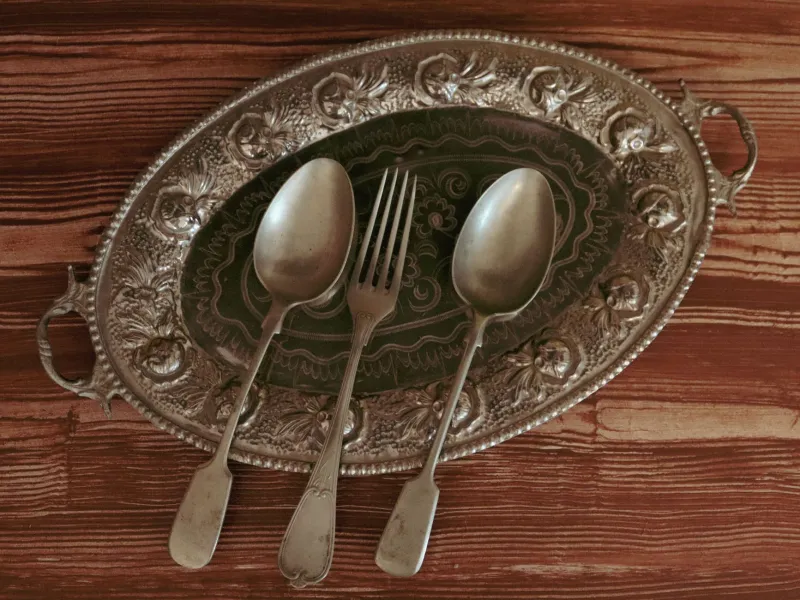
Charity-shop windows are not usually read as material libraries. Yet among the mismatched cutlery and tarnished napkin rings there is often solid silver: a spoon with a worn lion passant, a fork with a readable assay office mark, a christening set that has lost its box. For UK jewellery students, these objects can be a useful source of affordable metal and a lesson in restraint. The point is not to treat charity shops as a cheap shortcut. It is to approach second-hand flatware as a bench problem with a paper trail: identify it, test it carefully, plan cuts around its marks, anneal it without destroying its structure, and record what you have done.
Read the Object Before You Buy It
Begin with the marks, not the shine. UK silver flatware normally carries a set of hallmarks: a maker’s mark, an assay office mark, a date letter and a standard mark. For sterling silver, the standard mark is the lion passant; for Britannia standard, the figure of Britannia. The assay office mark may point to London, Birmingham, Sheffield or Edinburgh. A date letter can be useful for provenance, though it should not be treated as a valuation tool without further research.
Not every promising piece is solid silver. Electro-plated nickel silver is often stamped EPNS, EP, A1 or quadruple plate. Nickel silver contains no silver at all despite the name. A magnet is only a rough filter: it will not attract sterling silver, but it will not attract some other alloys either, so a non-magnetic result proves little. Weight, wear and the quality of the marks are better guides. Avoid pieces with deep splits, crude repairs, active corrosion or heavy monograms that would force the design into awkward compromises. Hollow-handled knives deserve particular caution; their interiors may contain resin, solder or other materials that make annealing unpredictable.
Test with Restraint, Record with Precision
A visual hallmark check is the first test, and for many student purchases it may be enough to justify a careful trial. Where doubt remains, use the least destructive method available. An XRF reading from a reputable scrap dealer or assay office can confirm composition without marking the surface. Acid testing should be a last resort, applied to a hidden area rather than the hallmark, and carried out with proper ventilation and eye protection. Never file across a hallmark to see what lies beneath; that removes the very evidence you need.
Record the object before you alter it. Photograph the whole piece, then take a close, sharp image of the hallmarks. Note the charity shop, date of purchase, price and any description given. Weigh the item. Write down the visible marks and any test results. This record is not bureaucracy for its own sake. It is the beginning of a provenance sheet that will support tutor review, design decisions and later hallmarking conversations.
Plan the Cut Around the Hallmark
A hallmark is not an obstacle to be removed. It is part of the object’s history and, in many student pieces, can become a feature. Design around it. A spoon bowl may become a pendant with the maker’s mark and lion passant left visible on the reverse; a fork handle may supply a narrow bar while the marked section remains intact. Avoid cutting through the hallmark unless there is a clear, documented reason and your tutor has approved the decision.
Make a paper template before you reach for the saw. Trace the shape you need and place it over the flatware so that the marked area falls outside the cut line or sits within a deliberate reserve. Leave a margin for filing and finishing. Flatware is often work-hardened and may have a slight curve or taper that affects the layout. Cut with a fine jeweller’s saw and a supported bench peg, keeping the blade upright and the work steady. If the piece is to be soldered later, consider how heat will affect any nearby marks; a heat sink or wet paper wrap can help, but it will not protect a hallmark from careless polishing.
Anneal Flatware Without Wrecking It
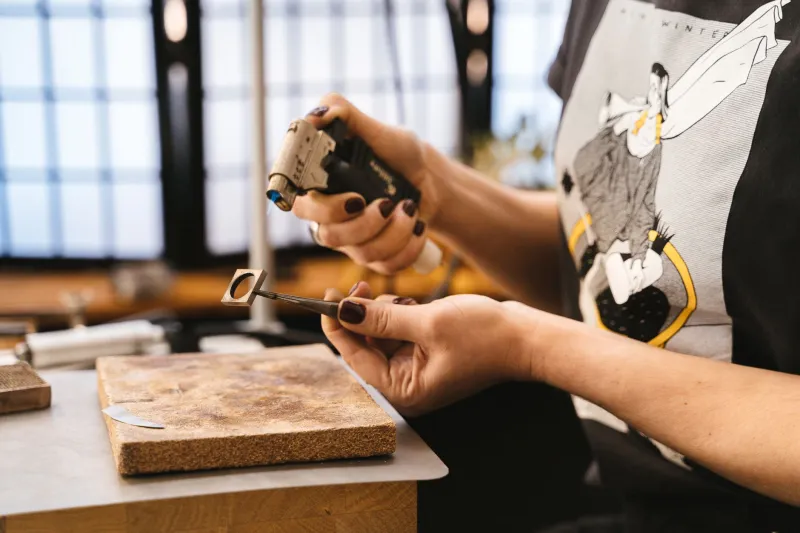
Solid silver flatware usually benefits from annealing before bending or forming, particularly if it has been work-hardened by years of use. Clean the area first and work in dim light so that colour is easier to judge. Heat evenly with a suitable torch, keeping the flame moving, until the silver reaches a dull red. Do not hold it there. Quench in water or allow it to cool according to the thickness and shape of the piece, then test the bend gently. Re-anneal if the metal stiffens again.
This is not a technique for plated pieces. Heat can blister or pit silver plate, and the base metal beneath may distort at a different rate. Hollow handles, soldered seams and composite objects should be set aside unless you fully understand their construction. Practise on a scrap spoon first. Learn how the metal moves, how quickly it loses colour and how much force it needs after annealing. The aim is control, not speed.
Form, File and Finish with the Marks in Mind
Once annealed, flatware can be bent over a wooden form, worked with a nylon mallet or drawn down with gentle pressure. Avoid abrupt folds. Silver that has been thinned by wear may crack at a sharp radius, so support the workpiece and anneal again if resistance rises. Files and abrasives should be used lightly around hallmarks; a polished-away mark is a lost record. If you solder a component near a hallmark, use the least heat that will do the job and shield the surrounding surface.
Keep a Provenance Sheet for Tutor Review
A finished student piece should be accompanied by a short, factual record. Include before-and-after photographs, hallmark close-ups, the charity shop and purchase details, the tests carried out, the cut plan, the final metal weight and a note of processes used. This sheet allows a tutor to assess judgement as well as making. It also prepares the ground for hallmarking conversations. In the UK, silver jewellery above the statutory exemption weight must be assayed and hallmarked, and an existing flatware hallmark does not serve as a hallmark for a new jewellery article. If the finished piece falls within the exemption, record that decision too.
Charity-shop silver is not a neutral material. It arrives with a previous life, a set of marks and a small paper trail. Treating those marks as evidence rather than inconvenience is part of the bench discipline Holt’s Academy expects. The result is not only a piece of jewellery but a defensible account of how it came to be.