Scrap as Evidence: A Labelled Fault Archive for the UK Jewellery Bench
Every jewellery bench produces scrap, and most of it is misfiled. A pierced sheet that tore at the sharpest curve, a ring band that opened at the joint, a setting that collapsed when the claw was pushed home: these pieces tend to end up in an unlabelled tin or, more often, in the bin. The loss is not sentimental. Each of those pieces is a physical record of a specific fault made under specific conditions, and once it is discarded the only remaining evidence is memory, which is unreliable at the bench. UK jewellery students are routinely asked to reflect on their practice; a fault archive gives that reflection something concrete to work from.
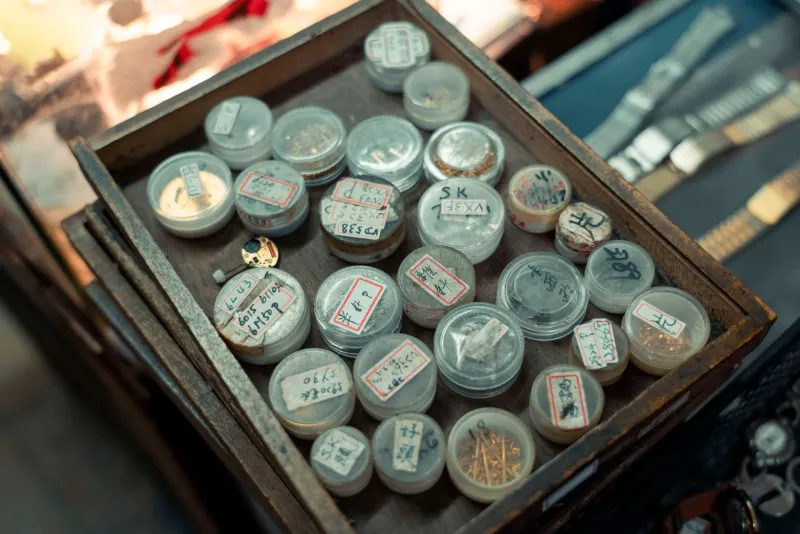
The proposal is simple. Rather than a general scrap tin, keep a dedicated drawer, box or compartment for failed work, and tag each item at the moment it fails. The tag should record the technique attempted, the fault observed and the date. Nothing more elaborate is required to begin, although the archive becomes more useful when a few additional details are added. What matters is that the record is made at the bench, not reconstructed later.
Why a bin is not an archive
A bin is a decision made in frustration. It removes the failed piece from sight and, with it, removes the possibility of diagnosis. An archive is a decision made deliberately: the piece is retained because it still has something to say. The distinction is not merely semantic. Students who discard failures tend to repeat them, because the fault is never examined closely enough to be recognised the next time it appears. Students who retain failures, labelled and dated, build a reference collection that becomes more useful the longer it is kept.
There is a second reason to keep the record. Faults at the bench are rarely random. A joint that opens is usually a preparation problem; a pierced line that wanders is usually a blade or posture problem; a setting that fails is usually a seat problem. Isolated, each failure looks like bad luck. Collected over a term, the same fault appears three or four times, and the pattern becomes impossible to ignore. The archive converts a series of annoyances into a diagnosis.
What the tag must record
Three fields are essential. The first is the technique attempted: piercing, soldering, stone setting, annealing, forming, finishing, or any other named operation. The second is the fault observed, described in plain and specific language. "Bad solder" is not a fault description; "joint opened on the second heat, seam not closed before soldering" is. The third is the date, which allows the archive to be read in sequence and compared with a student's logbook or assessment record.
Two further fields are worth adding where possible. The first is the material, since copper, gilding metal, brass and silver behave differently and a fault in one is not always a fault in another. The second is the stage at which the fault was noticed, because a fault found at the bench before finishing is a different problem from one found after polishing. A short note on the suspected cause is useful but should be treated as provisional; the point of the archive is to test hypotheses, not to confirm them too early.
Triage: repairable, teachable, terminal
Not every failed piece belongs in the archive permanently. A simple triage at the point of tagging keeps the drawer useful and prevents it from becoming a general scrap store. Three categories are enough. Repairable pieces are those where the fault is understood and the piece can be returned to the bench; these should be tagged and returned to the work in progress, not left in the drawer. Teachable pieces are those where the fault is instructive but the piece is not worth repairing; these form the core of the archive. Terminal pieces are those where the metal is better reclaimed than retained, and these should be sent to the scrap stock with the tag recorded in the logbook before the piece is melted or exchanged.
The triage is the part students most often skip, and it is the part that prevents hoarding. An archive without triage becomes a drawer of guilt. An archive with triage becomes a working reference.
Keeping the drawer from becoming a hoard
The failure archive is a diagnostic tool, not a store of shame or a substitute for the scrap pot. Two disciplines keep it in order. The first is a cap: a set number of items, or a set number of months, after which the archive is reviewed. At each review, items are re-read against the logbook, patterns noted, and any item that has been superseded by a later, clearer example is retired. The second is a simple index, kept in the logbook or on a card inside the drawer, listing the tag number, technique and date. An unindexed drawer is a pile; an indexed drawer is an archive.
Reviewing the archive at the end of a term is a short exercise and a useful one. Students who read their own fault record in sequence tend to notice that a particular fault clusters around a particular tool, a particular time of day, or a particular stage of a project. That is exactly the kind of insight a bench log is meant to produce, and it is difficult to reach without physical evidence.
Resilience, not rumination
There is a risk that a failure archive encourages students to dwell on mistakes. Handled well, the opposite is true. The tag separates the fault from the student: the piece is not a verdict on ability but a specimen of a technique that did not go as intended. That separation is precisely what resilience at the bench requires. A student who can name a fault, date it and file it is a student who can move on to the next piece without either denying the problem or being stopped by it.
In UK training, where assessment often rewards finished work, the archive also protects the learning that happens in the failures. A well-kept drawer is evidence that a student has rehearsed a technique repeatedly and has the record to prove it, which is a more honest picture of progress than a portfolio of successful pieces alone.
Starting the archive on Monday
The archive does not require new equipment. A shallow drawer, a lidded box or a compartment in the bench tidy will do, provided it is separate from general scrap. Tags can be card and string, masking tape and a permanent marker, or small paper envelopes for very small items; the method matters less than the consistency. The first entry should be made at the next failure, not at the next tidy-up.
A failure archive is a modest habit with a long return. It asks for a tag, a date and a sentence at the moment of frustration, and in exchange it gives the student a record of their own technique that no textbook can supply. Broken work deserves a label, provided the label is a diagnosis and the drawer is reviewed.