Separate, Record, Reconcile: Metal Stock Discipline for UK Jewellery Benches
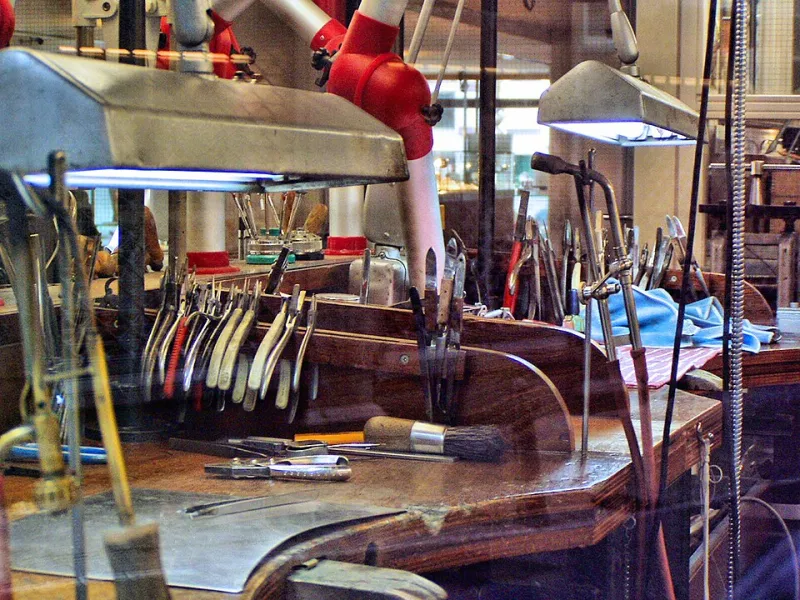
Photo: Marek Ślusarczyk (Tupungato) Photo portfolio, CC BY 3.0, via Wikimedia Commons
At a shared student bench, metal rarely stays where it was put. A length of sterling wire migrates into a tray of base-metal offcuts; a few gold filings cling to a bench brush; a jar of unidentified scrap becomes the resting place for three different alloys. The result is not merely untidy. It is a technical problem that shows up later as a failed solder joint, an inaccurate cost calculation or an awkward conversation at the assay office.
The remedy does not require an expensive storage wall or a laboratory-grade inventory system. It requires a small number of labelled containers, a set of consistent habits and a ledger that is simple enough to be maintained on a busy teaching bench. For UK jewellery students in 2026, metal stock discipline is best understood not as paperwork but as a bench skill.
Why separation is a technical matter
Precious metals are forgiving in many respects, but they are not indifferent to contamination. A fragment of leaded solder in a sterling silver crucible can produce porosity. Base-metal filings mixed into silver swarf can alter the behaviour of a melt. Gold of one alloy mixed with gold of another becomes difficult to describe accurately, and therefore difficult to hallmark or sell with confidence.
The problem is compounded by scale. At a small UK bench, quantities are often modest: a few grams of offcuts, a small bag of filings, a short length of wire. These are precisely the quantities that are easy to overlook and difficult to identify once mixed. A jar without a label is not a stock item. It is mystery metal, and mystery metal has no reliable place in hallmarkable work.
Traceability also supports costing. A student who knows that a pair of earrings consumed 4.2 grams of sterling silver, rather than an approximate handful from an unlabelled tin, can begin to price work with something closer to accuracy. The same record helps when a piece is sent for assay, because the metal can be described with confidence rather than guesswork.
A labelling grammar that survives the week
The first requirement is a label that remains legible after a week of bench work. Permanent marker on masking tape is not sufficient. Labels should be written directly on the container or on a durable tag, and they should carry more than the alloy name.
A useful label records the alloy, the form, the date the container was opened and, where relevant, the source. For example: Sterling 925, sheet offcuts, opened 14 October 2026, student bench 3. Fine silver, castings, received 02 November 2026, supplier batch A. Gold, 18ct yellow, filings, sealed 09 October 2026.
Abbreviations should be avoided unless they are unambiguous across the whole workshop. The label 925 is useful, but Ag925 or Sterling 925 is clearer. The label FS should not be left to stand for both fine silver and filing scrap. Colour coding can provide a secondary cue, but colour alone is not a label. A red lid does not tell a new student what is inside.
Every bench should also have a container marked Unknown, with a date. This is not a licence to abandon identification. It is a temporary holding place for metal that cannot be assigned with confidence. Material in the Unknown container should not be used in hallmarkable work until its identity has been established, and in most student settings it is better treated as practice metal.
Storage by alloy, form and risk
Storage should separate metal by alloy and by form. Sterling silver sheet, sterling silver wire and sterling silver castings may share a drawer, but they should not share a single unlabelled tin. Fine silver should be kept apart from sterling silver because the two behave differently in soldering and melting. Gold should be kept separately, both because of value and because of alloy confusion. Base metals, including copper, brass and nickel silver, should have their own zone.
Form matters as much as alloy. Offcuts that can be identified by shape and size are easier to reuse than filings and sweeps. Swarf, which includes filings, saw dust and bench sweepings, should be kept in sealed containers and should never be mixed with solid offcuts. Once mixed, the solid pieces become difficult to recover cleanly.
At a small UK bench, a simple system of closed tins, grip bags and shallow drawers is usually sufficient. The important principle is that containers remain closed when not in use. Open trays invite cross-contamination from adjacent work, and they allow small pieces to migrate. Lids should be labelled as well as containers, because lids are often separated during use.
Interrupting the contamination pathways
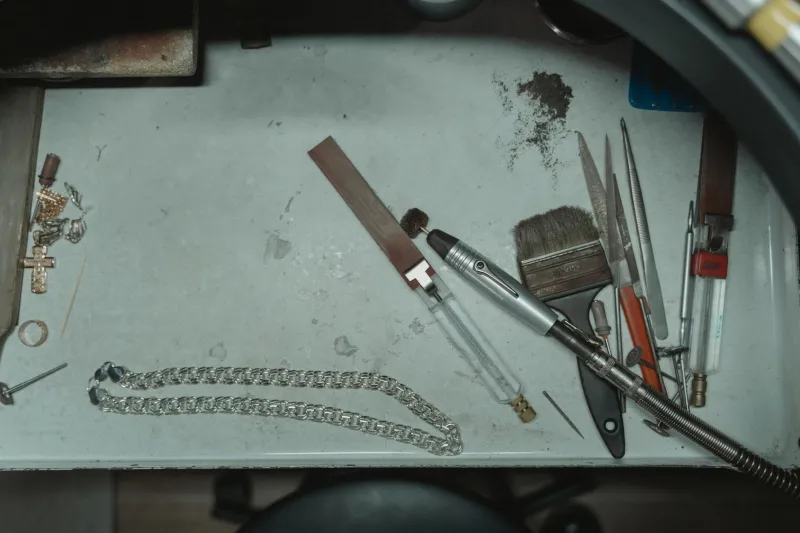
Contamination is rarely the result of a single careless act. It accumulates through shared tools and shared surfaces. A file used on brass and then on sterling silver will carry base-metal particles. A bench brush used across the whole bench will redistribute swarf. A soldering block used for leaded solder and then for precious metal work can introduce unwanted residues.
A practical student routine is to assign tools where possible and to clean between metals. Files and brushes can be kept in separate labelled zones. Tweezers used for solder should not be used to retrieve stock from a container. Solder itself should be stored away from metal stock, with hard, medium and easy grades labelled clearly. The solder jar is not a stock jar.
Bench surfaces should be cleared between tasks, and the bench tray should be emptied into the correct container rather than into a general scrap tin. These are small actions, but they interrupt the pathways by which one alloy enters another.
The stock ledger as a bench record
A stock ledger does not need to be elaborate. An A5 notebook or a simple spreadsheet can record the date, alloy, form, description, mass in, mass out, balance and notes. A scale accurate to 0.01 grams is adequate for most student work, though gold may justify finer measurement.
The ledger should be updated when metal is received, when it is issued to a project and when offcuts are returned. It should not be updated from memory at the end of term. A monthly reconciliation, in which the recorded balance is compared with the weighed contents of the container, will reveal losses, mislabelling and contamination before they become expensive.
This record supports costing, but it also supports hallmarking decisions. UK assay offices deal in clear descriptions. A piece described as sterling silver should be made from stock that can genuinely be identified as sterling silver. The ledger provides the supporting narrative.
A beginner-friendly weekly routine
A ten-minute sort at the end of each week is enough to prevent most problems. Clear the bench tray and sort solid offcuts from swarf. Return identifiable offcuts to their labelled containers. Seal swarf in its own container. Weigh the contents of any container that has been used during the week. Update the ledger. Check that labels are legible and that lids are matched to containers. Place any uncertain material in the dated Unknown container.
The routine should be repeated even in weeks when little work has been done. Consistency matters more than volume. A bench that is sorted every week remains legible; a bench that is sorted once a term becomes an archaeological exercise.
Metal stock discipline is not the most visible part of jewellery training, but it underpins the visible parts. It reduces failed solders, improves costing and makes hallmarking decisions more straightforward. For UK jewellery students, the labelled jar is not a bureaucratic object. It is a small instrument of good craft.